Field guide · Choosing the display
Projector or TV for a classroom?
First published by Neon+ (ES PRODUCATION SDN BHD) on espg.com.my; updated 20 Oct 2026 for the group site.
The short answer
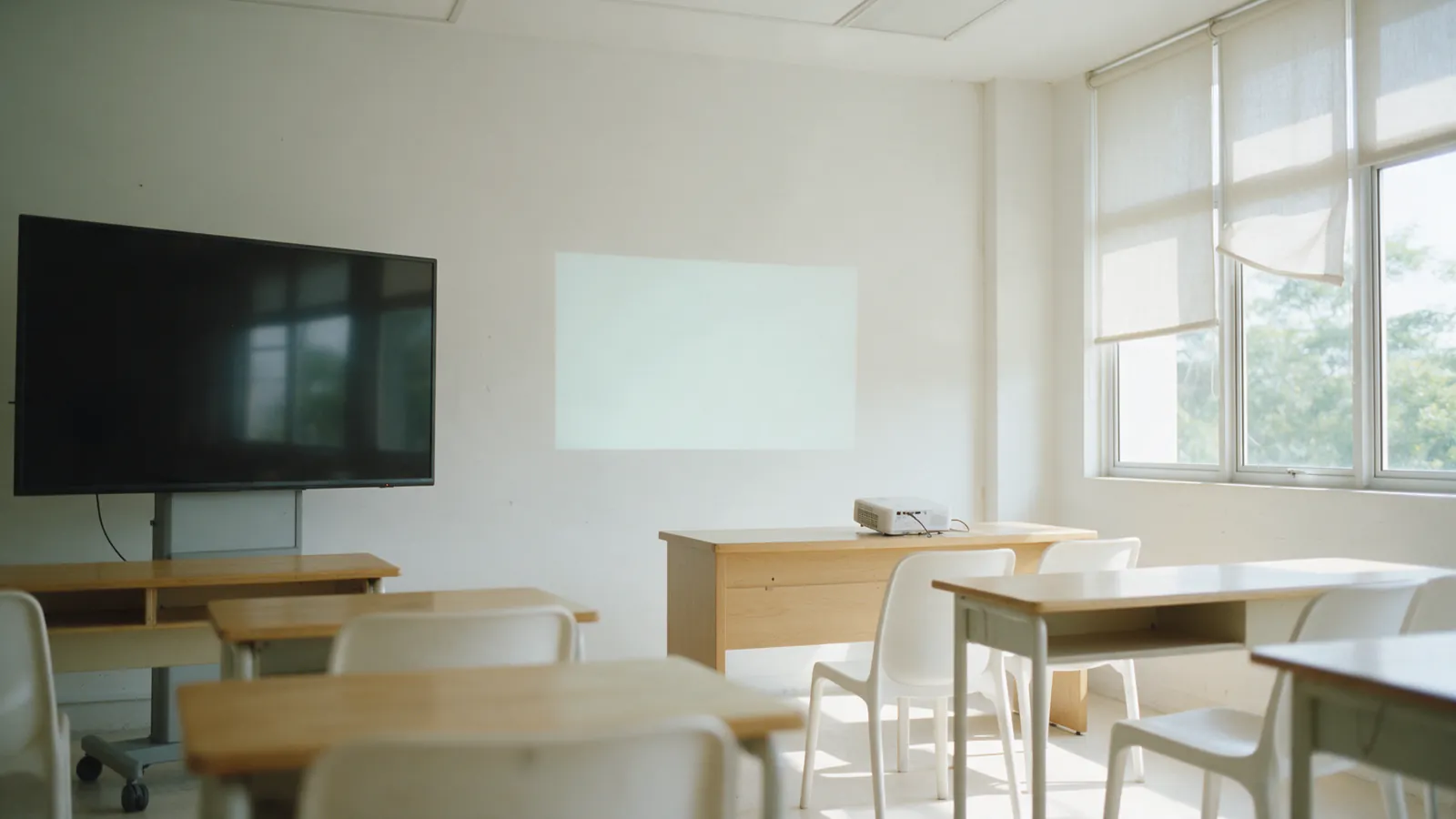
A projector suits a classroom whose back row sits too far away for a flat panel (beyond about 4.5 m for detailed work), or whose display has to move between rooms. A TV suits a small, permanently bright room where pupils write on the screen. The classroom TV in this comparison is the interactive flat panel schools actually buy, which BenQ puts at 65 to 90 inches, not a domestic television.
Every Neon+ figure on this page is as Neon+ (ES PRODUCATION SDN BHD) publishes it on neonplus.com.my; figures from other makers and sources are attributed where they appear.
Key takeaways
What decides it between a projector and a TV?
- Start at the last row. Epson's 4/6/8 rule puts detailed work at no more than four times the screen's vertical height. Measure to the furthest seat first.
- A classroom TV stops at a size. BenQ says “most of the screens used in interactive teaching are between 65 and 90 inches”. A projected image grows by moving the projector back.
- Daylight is the projector's limit. BenQ: projectors “rely on low ambient light to create contrast”. Indiana Wesleyan University says a panel's image “is brighter than most projectors can achieve in a well-lit classroom or lab”.
- Count the rooms, not the screens. Neon+ publishes the V6 at 786 g with a tripod in the box. A flat panel stays on the wall it is mounted to.
- Cost scales with size. Tech & Learning's 2017 comparison put a projected image at “roughly half the cost of similarly sized flat panels”.
Method and scope Neon+ (ES PRODUCATION SDN BHD), the group's projector company, wrote this guide; “we” and “our” on this page mean the Neon+ team. The two display categories compared on what their makers, an independent education-technology publication and a university IT department publish, with viewing distances worked from Epson’s 4/6/8 rule and the Neon+ V6’s published specification. No figure here is a performance claim for a Neon+ model beyond what Neon+ publishes. Reviewed 18 Oct 2026.
On this page9
Which three questions decide between a classroom projector and a TV?
Three questions decide between a classroom projector and a flat-panel TV. How far back the last row sits, because that sets the image size the room needs. How much daylight reaches the front wall, because a projected image depends on it. And whether the display stays in one room or travels between them.
Know your room's depth and windows? WhatsApp the room measurement to Neon+ on +60 12-565 2091, or read the published figures on the Neon+ V6 specification page.
| What is true of your classroom | Points to | Why |
|---|---|---|
| The last row is beyond about 4.5 metres | Projector | A 90-inch panel is the usual ceiling, and 4.5 m is its limit for detailed work |
| Blinds stay open all day | TV (flat panel) | Projected contrast falls as room light rises |
| One display, several rooms | Projector | Neon+ publishes the V6 at 786 g, with a tripod in the box |
| Pupils write on the screen every lesson | TV (flat panel) | Multi-point touch is built into the panel |
| No mounting or wiring approval yet | Projector | Nothing is fixed to the wall |
Which display reaches the back row of a classroom?
A classroom display reaches the back row when its image is big enough from the furthest seat. Epson's 4/6/8 rule caps the viewing distance at four times the screen's vertical height for analytical viewing, six for basic presentations and eight for passive viewing such as video. A flat panel's height is fixed when you buy it; a projected image's height is set by where the projector stands.
That rule is what makes the panel's size ceiling matter. BenQ says “most of the screens used in interactive teaching are between 65 and 90 inches” — larger panels exist, but are not what classrooms usually buy — while projectors can “show a larger size screen simply by moving the projector farther back”. Neon+ publishes the V6 at a 1.2:1 throw ratio, a 39-inch frame at one metre, so one unit covers a small room and a long one (on neonplus.com.my).
| Display | Image height | Detailed work, 4× | Presentations, 6× |
|---|---|---|---|
| 65 in TV (flat panel) | 0.81 m | 3.2 m | 4.9 m |
| 90 in TV (flat panel) | 1.12 m | 4.5 m | 6.7 m |
| 100 in Projected | 1.25 m | 5.0 m | 7.5 m |
| 120 in Projected | 1.49 m | 6.0 m | 9.0 m |
| 150 in Projected | 1.87 m | 7.5 m | 11.2 m |
90 in TV (flat panel)1.12 m high · detailed work to 4.5 m · presentations to 6.7 m
120 in projected1.49 m high · detailed work to 6.0 m · presentations to 9.0 m
The distances are arithmetic: a 16:9 diagonal converted to height, then multiplied by Epson's factors. BenQ lands in the same place — “a 100 inch display… for analytical viewing up to 16 feet away”, 4.9 metres against the table's 5.0. Our guide to how big a classroom projector image should be works the sum from your own back row.
What does classroom daylight do to a projector and a TV?
Daylight is the condition most likely to decide against a projector. BenQ states that projectors “rely on low ambient light to create contrast”, and that “the bright lights of a classroom lower the contrast on a projected image – making it harder to read”. A flat panel generates its own light rather than reflecting it off a wall.
Does daylight rule a projector out?
Only in a room whose blinds are never closed. A projector works in any classroom whose blinds are actually drawn for the lesson, at an image size its brightness can light; the honest test is whether a teacher will draw them every time. Indiana Wesleyan University's IT guidance puts the panel's side plainly: its image “is brighter than most projectors can achieve in a well-lit classroom or lab”. Neon+ publishes the V6 at 600 ANSI lumens; our guide to room light, image size and brightness (on neonplus.com.my) covers the trade.
Does a teacher cast a shadow on the image?
A teacher standing in the beam blocks a projected image, and a flat panel does not have the problem: Tech & Learning notes that with a projector “students or teachers block the projected image”. A panel has its own version. Indiana Wesleyan University notes it “can be adjusted manually to avoid glare from lights, or reflection of light from windows or doors” — direct glare a matt projection screen does not get as a reflection, though room light still washes a projected image out, as the daylight answer above says. Where the projector sits decides how often a shadow happens.
Does the classroom display need to move between rooms?
If the display has to move between rooms, that settles it in the projector's favour. A flat panel is mounted where it is installed, so one panel serves one room for its whole life. A portable projector goes to whichever classroom has the lesson.
Neon+ publishes the V6 at 786 g and 220 × 127 × 46 mm, with a tripod, remote, adapter, power cord and HDMI cable in the box. It has no built-in battery and runs from a 19 V / 3.42 A adapter, so every room it visits needs a power point within reach. Some other Neon+ models (the C2000, K5 and V8) are published with a built-in battery, which removes that constraint; the battery or externally powered guide (on neonplus.com.my) sets out the difference.
Sharing a travelling projector is a timetable job rather than a technical one: our guide to sharing one projector between classrooms covers the booking, the trolley and the pre-lesson checks.
Can pupils write on the screen?
Writing on the screen is the flat-panel TV's strongest case, and a projector on its own does not do it. BenQ describes interactive panels with “up to 40 points of touch, enabling multiple students to easily write on the screen at the same time”, though “the most popular models only enable six points of touch”.
The question for a school is how often the lesson needs it. Where pupils come to the front and annotate the screen daily, that is a panel job; where the display shows slides and video to seated pupils, the touch hardware is an expense the timetable never uses. Tech & Learning puts flat panels in “Study spaces designed for group projects and interaction” and projectors in “Large classrooms, study areas where ambient light can be controlled, lecture halls and band rooms”.
What do a projector and a TV cost to buy and to keep running?
A projector buys more screen for the money (about half the cost per screen size, on Tech & Learning's 2017 comparison); a flat-panel TV asks less of the people who run it. The purchase gap is the larger difference and it widens with size, because a panel's price climbs with its diagonal while a projected image grows by moving the projector back.
What is the purchase gap?
Independent publication, 2017
The independent education-technology publication Tech & Learning put it this way in a 2017 comparison: “At roughly half the cost of similarly sized flat panels, a projected image can cover a wall”, with panels running “up to double what a similar sized projector option involves”.
A projector maker
Epson argues the same side: “Flat panels have cost advantages in some cases, but projector prices are competitive and offer hands-down better viewability”.
Both are vendor-adjacent views and both are dated (Tech & Learning is independent but its figure is from 2017; Epson sells projectors); with no verified current Malaysian panel price in our records, this guide compares categories rather than one product against another. Neon+ publishes prices per model; confirm them before a purchase order.
What does each need to keep running?
BenQ notes that “nearly every popular model of classroom projectors using LCD technology requires regular filter cleaning”. Neon+ publishes the V6 as a Texas Instruments DLP unit with an Osram RGB-LED light source, a different imaging category from the LCD models in that warning. The V6 specification Neon+ publishes does not say whether it has a filter, so ask. A flat panel has no filter and no light-source module to service, which is the upkeep argument for a panel. Our guide to how long a classroom projector lasts turns those hours into school years, and Neon+ warranty, delivery and support (on neonplus.com.my) sets out the 365-day local warranty.
So which should a Malaysian school buy, a projector or a TV?
A Malaysian school should buy the projector for a deep classroom with workable blinds: it is the only option, within the 65 to 90 inch panels BenQ says classrooms usually buy, that puts a 100-inch or larger image in front of the back row. It should buy the flat-panel TV for a small, permanently bright room where pupils write on the screen every lesson. Where there are more rooms than budget, one portable projector covers several timetables.
Buy the projector when
- the back row sits beyond about 4.5 m for detailed work
- the blinds are drawn for the lesson
- one display has to serve several rooms
Buy the flat panel when
- the room is small
- it stays bright all day
- pupils write on the screen every lesson
Write three measurements down before you shortlist a model:
- metres from the front wall to the furthest seat,
- how the room behaves with the blinds closed at 11am,
- and how many rooms the display has to serve.
Those decide the category. Our guides to choosing a portable projector (on neonplus.com.my) and to setting up a classroom projector in Malaysia (on neonplus.com.my) take it from there.
Send us the room, not the model number. Tell the Neon+ team how far back your last row sits, how the room behaves with the blinds closed, and how many classrooms the display has to serve. They will tell you whether a projector is the right category for it, and which model fits. WhatsApp Neon+ on +60 12-565 2091 · Call +60 12-565 2091 · info@neonplus.com.my.
Neon+ is a projector specialist rather than a general display seller: a 365-day local warranty with 1-to-1 replacement for qualifying faults, free delivery above RM50 including Sabah and Sarawak, a showroom in Ipoh and branches in Kota Kinabalu and Sibu. ASEAN Records recorded 372 Neon+ portable smart projectors sold in May 2025, worth over RM1.41 million — one month's result, not a monthly rate. The Ipoh showroom opens 9am–5pm Monday to Friday and 9am–1pm Saturday; call ahead for the branches.
Quick answers
What else do schools ask before they choose?
Does a projector need a proper screen, or will a classroom wall do?
A flat, pale, matt wall is a workable surface. Texture, colour and a glossy paint finish all cost contrast, so a wall that works for slides can struggle with photographs and fine text. Before changing the projector, read our guide to room light, image size and brightness (on neonplus.com.my).
Which Neon+ model should a school look at first?
The Neon+ V6 is the model whose published specification this guide quotes in full: 1280 × 800 native resolution, 600 ANSI lumens, a 1.2:1 throw ratio and no built-in battery. Some other Neon+ models (the C2000, K5 and V8) are published with a built-in battery, which matters if a room has no convenient socket. Prices are published per model and the figures in our records are dated August 2026 (prices captured from neonplus.com.my in August 2026; Neon+'s listed prices were re-read unchanged on 20 October 2026), so confirm the current price with the team.
Will the school's existing laptop work with either one?
Neon+ publishes the V6 with HDMI 2.0, two USB 2.0 ports, Ethernet, Wi-Fi on 2.4G and 5G and Bluetooth 5.0, which covers the way most school laptops connect. The thing worth checking before you buy is the difference between a projector's native resolution and the input resolutions it accepts — our native resolution versus supported input guide (on neonplus.com.my) explains why a sharp-looking spec can still soften text.
How long does delivery take to a school outside Ipoh?
Neon+ publishes dispatch within 3 working days and free delivery on orders above RM50, including Sabah and Sarawak, with RM8 flat delivery below that. East Malaysia delivery may take up to 3 weeks. A school ordering for the start of a term should work backwards from those figures rather than from the dispatch date alone.
Sources
Where do the figures on this page come from?
- BenQ, “Projector vs. Interactive Display”: projectors relying on low ambient light for contrast and classroom lights lowering it; interactive teaching screens being between 65 and 90 inches; a projector showing a larger image by being moved farther back; a 100-inch display for analytical viewing up to 16 feet; LCD classroom projectors requiring regular filter cleaning; and the 40-point and six-point touch figures. BenQ makes both categories.
- Tech & Learning, “Displays vs. Projectors” by Sascha Zuger, 9 November 2017: a projected image at roughly half the cost of similarly sized flat panels and panels running up to double; students or teachers blocking the projected image; and the room types each suits. An independent education-technology publication; the cost comparison is from 2017 and is not a Malaysian price.
- Indiana Wesleyan University, “Flat Panel Display in Classrooms and Labs”: a panel's image being brighter than most projectors can achieve in a well-lit classroom or lab, and a panel needing manual adjustment to avoid glare from lights or reflection from windows or doors. A university IT department's own guidance.
- Epson, “Projectors and flat panels: choosing classroom displays”: Epson's own position that flat panels have cost advantages in some cases but projector prices are competitive and offer better viewability. A projector maker's opinion, quoted as such.
- Epson, “Display size matters”: the 4/6/8 rule — a maximum viewing distance of four times the screen's vertical height for analytical viewing, six for basic and eight for passive.
- Neon+ V6 product page: 1280 × 800 native resolution, 600 ANSI lumens, 1,000:1 full-on/full-off contrast, the 1.2:1 throw ratio and 39-inch frame at one metre, 786 g, 220 × 127 × 46 mm, Texas Instruments DLP with an Osram RGB-LED light source, HDMI 2.0, USB 2.0, Ethernet, Wi-Fi and Bluetooth 5.0, no built-in battery, a 19 V / 3.42 A adapter and the box contents. V6 only; do not read these as figures for another model.
- Neon+ FAQ: the 365-day local warranty with 1-to-1 replacement, dispatch within 3 working days, free delivery above RM50 and RM8 below it, East Malaysia delivery of up to 3 weeks, and the Ipoh showroom hours.
- ASEAN Records, 24 September 2025: 372 wireless all-in-one portable smart projectors sold in May 2025, worth over RM1.41 million. One month's result, not a recurring monthly figure.
The viewing-distance table is arithmetic: a 16:9 diagonal converted to vertical height, then multiplied by Epson's 4× and 6× factors. The BenQ, Epson, Tech & Learning and Indiana Wesleyan material explains the two display categories and proves nothing about any Neon+ model.
Contact
Talk to the group.
For projector questions, models and orders, Neon+’s own site is neonplus.com.my. Schools and institutions, educators, partners and suppliers: one contact for the whole group, +60 12-565 2091. The same number reaches Neon+ for projector questions.
Contact details
- Phone
- +60 12-565 2091 (also WhatsApp)
- info@neonplus.com.my
- Head office
- 46, Jalan Lang Indah A/1, Pusat Perniagaan Lang Indah, Ipoh, Perak
- Hours (Ipoh showroom)
- Monday to Friday, 9am to 5pm
Saturday, 9am to 1pm